



Good evening, and welcome to Raw America. I’m British Chris.
Republicans are quietly turning on Trump’s war in Iran. The Supreme Court just handed Republicans a redistricting sledgehammer, though one Republican governor is turning it down. Raw America was on the ground in Washington for an event at the Supreme Court. And tens of thousands of workers, students, and union members took to the streets today for May Day. Let’s get into all of it.
Raw America is unbought, editorially independent and not for sale. Independent media is more important now than ever before, with right-wing billionaires Larry and David Ellison now controlling CNN and about to own CNN. This means two Trump megadonors are about to have final say over what two of the biggest news outlets in the world will and won’t cover. This is all while Trump’s FCC is actively threatening the broadcast licenses of any news outlet running coverage they don’t like.
Independent outlets like Raw America aren’t beholden to billionaires. We don’t cower in fear of a wealthy backer or a corporate advertiser, which is why you’ll find perspectives here you won’t find on CBS. But our independence only exists because of paying subscribers. If you believe journalism should answer to the public and not to the donor class, subscribe to Raw America today.
Now, let’s get into the news.
Republicans Turning on Trump Over His War in Iran
Something significant is shifting inside the Republican Party, and it’s been building for weeks.
Key Republicans in Congress are starting to publicly break with Donald Trump over the war in Iran. And this isn’t just a few moderates grumbling quietly in the hallways. These are senators going on the floor, threatening votes, and demanding answers.
Here’s the context. The War Powers Resolution, a law passed after Vietnam specifically to rein in presidential war-making, gives the president 60 days to get congressional authorization for military action. That 60-day clock ran out on Friday.
Trump’s response? He declared the hostilities have “terminated” because of a cease-fire agreement with Iran. But here’s the thing: the U.S. naval blockade of the Strait of Hormuz is still in place. American forces are still there. Legal scholars across the political spectrum called the administration’s argument a stretch, at best.
And some Republicans aren’t buying it either.
Senator Lisa Murkowski of Alaska is threatening to force a vote this month on legislation that would authorize the war but, in her words, would “not be a blank check.” It’d require the president to provide metrics for success, notice of any changes in objectives, and a plan for getting out.
Senator Susan Collins of Maine actually flipped her position this week, voting for the first time with Democrats on a resolution to halt the war. She was blunt about it. “That deadline is not a suggestion; it is a requirement.”
Senator Josh Hawley, no liberal, said he doesn’t want to open up further conflict. He wants to wind it down.
And here’s what’s driving a lot of this, beyond principle. Midterm elections are six months away. The war is deeply unpopular. Gas prices are up. Consumer goods are more expensive. Democrats are hammering Republicans for backing an unauthorized war while everyday Americans feel the squeeze. The political math is changing fast.
Republicans spent months arguing Trump had open-ended authority to conduct what he originally called a swift, decisive operation. They’re rethinking that now. Whether they do anything meaningful about it is another question entirely.
Raw America On the Ground for Day of Action Outside Supreme Court
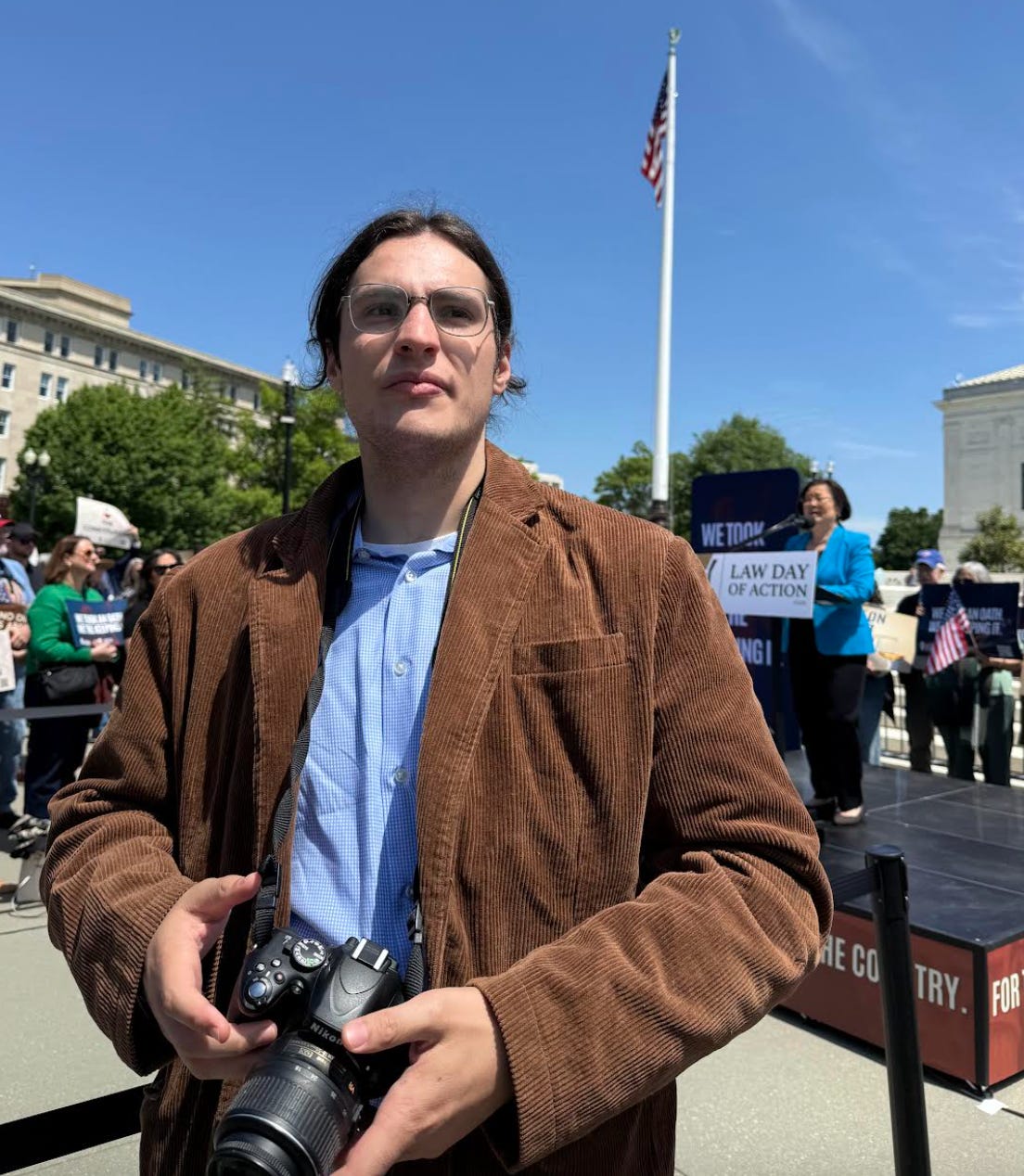
Raw America capitol reporter Luke De Cresce at the Supreme Court with Sen. Mazie Hirono (D-Hawaii) in the background, May 1, 2026 (Photo: Luke De Cresce / Raw America)
Today, Raw America capitol reporter Luke De Cresce was on the ground outside the Supreme Court for the Law Day of Action. The day of action — which was organized by organizations like Lawyers for Good Government and Legal AF — involved attorneys across the country gathering at courthouses and other public spaces to retake their oaths, and demand the government adhere to the rule of law.
DC’s event was attended by Rep. Glenn Ivey (D-Md.) and Sen. Mazie Hirono (D-Hawaii), who both spoke about the conservative Supreme Court majority’s recent ruling that gutted the Voting Rights Act, and other extreme rulings by the Roberts Court. Speakers also condemned the Roberts Court’s 2024 Trump v. United States ruling, which allows presidents to be immune from all criminal prosecution for anything deemed an official act.
The legal community taking their oaths to the Constitution seriously is encouraging to see at a time when the rule of law is under attack. The bigger question, though, is whether the six unelected conservatives in black robes take that oath seriously as they continue to enable Trump’s rapid consolidation of power.
Georgia’s GOP Governor Shuts Down Republican Gerrymandering Efforts
The Supreme Court handed down a decision this week that’s going to reshape congressional maps across the South, and the scramble is already underway. But not in one key Souther state.
The ruling in Louisiana v. Callais struck down a Louisiana congressional district that had been drawn to create a second majority-Black seat. And it didn’t take long for Republican governors to read the room.
Louisiana’s Governor Jeff Landry moved immediately to cancel his state’s upcoming primary, days before early voting was supposed to begin, so the maps could be redrawn. Trump weighed in too, saying he’d spoken to Tennessee’s governor and that Tennessee would be moving to eliminate a Democratic-held seat.
But this Supreme Court ruling opens a new front. Republicans in Southern states are now pushing hard for last-minute redraws that could eliminate majority-minority districts, all under the banner of the court’s new framework.
Georgia’s outgoing Governor Brian Kemp said he won’t participate this cycle. Voting’s already underway in Georgia, and the logistical window is closed. But he was clear that Georgia will need new maps before 2028.
This is the long game. The Voting Rights Act, as it’s been understood for decades, is being dismantled piece by piece. And the political beneficiaries of that dismantling aren’t exactly hiding it. Georgia’s decision to not participate is particularly significant, given how its neighbors are acting.
May Day 2026 Is Bigger Than It Looks
Today was International Workers’ Day, and it was actually much bigger than the billionaire-owned media outlets would have you believe.
Across the country, roughly 3,500 events took place under the banner of “May Day Strong.” Organizers called for no school, no work, no shopping. And a lot of people showed up.
In New York City, Sunrise Movement protesters chained themselves to the front of the New York Stock Exchange. In Portland, protesters occupied a hotel lobby where DHS officials were reportedly staying. In Minneapolis, six people were arrested blocking a bridge. In Memphis, protesters lay in the street blocking the entrance to Elon Musk’s xAI datacenter. In Washington, D.C., demonstrators shut down intersections holding banners that read “Workers over billionaires” and “Healthcare not warfare.”
Chicago teachers won the right to have May Day declared a “day of civic action.” At least 15 school districts in North Carolina gave teachers the day off to attend a statewide rally for public education funding. Schools were canceled in Madison and Milwaukee, Wisconsin.
Amazon workers and Teamsters marched on Amazon’s corporate offices in New York, demanding the company cut its contracts with ICE and the Department of Homeland Security.
What makes today significant isn’t any single protest. It’s the convergence. Labor unions, immigrant rights groups, climate activists, teachers, students, democratic socialists, all showing up together around a shared set of demands: no ICE, no unauthorized war, tax the rich, protect workers.
Leah Greenberg of Indivisible called today a “structure test” for the movement. Organizers are building toward something bigger, including a potential push for a general strike by May 1, 2028, with UAW president Shawn Fain leading that charge.
Help Raw America Stay Independent
Raw America’s Capitol reporter is providing more more on-the-ground coverage of Congress. We’re bringing exclusive interviews with newsmakers who are offering perspectives the mainstream media won’t touch, because they don’t have to answer to the same corporate interests. Today we spoke to Florida Democratic Party Chair Nikki Fried about Ron DeSantis’ new gerrymander, which you can view below.
None of this is possible without paying subscribers. We don’t rely on a billionaire writing checks to keep us afloat. If you want journalism that doesn’t live in fear of censorship from right-wing oligarchs, subscribe to Raw America today. The link is below. It matters more than ever.
Thanks for watching. I’m British Chris. We’ll see you next week.
STORIES YOU MAY HAVE MISSED:
Trump Tries to Argue Iran War Is Over as 60-Day Deadline Approaches. President Donald Trump on Friday argued to Congress that a War Powers Act vote is unnecessary, given the current ceasefire with Iran. May 1 marks 60 days since the first American and Israeli attacks on Iran, meaning that under the War Powers Act of 1973, Congress would have to authorize additional military action in Iran, or else Trump would have to notify Congress of a 30-day withdrawal period. As of Friday, U.S. troops are still stationed in the Middle East near Iran, and the U.S. Navy is still conducting its own blockade of the Strait of Hormuz.
Trump Withdraws 5,000 U.S. Troops from Germany. Trump followed through on his threat to decrease the number of American service members stationed in Germany by announcing a withdrawal of 5,000 troops (out of roughly 35,000) on Friday. The president previously threatened to pull out troops in response to German Chancellor Friedrich Merz commenting to a group of students that the U.S. “quite obviously went into this war [in Iran] without any strategy.” The German government has long advocated for U.S. troops to be stationed in Germany in order to provide support for NATO allies and logistical assistance for American forces throughout Europe.
Louisiana Voters Sue Governor Over Suspension of Primaries. Louisiana Republican Gov. Jeff Landry is now a defendant in multiple lawsuits after announcing the suspension of the Bayou State’s primary elections this week. Landry made the announcement in the wake of the Supreme Court’s decision in the Louisiana v. Callais decision, which weakened Section 2 of the Voting Rights Act (pertaining to racial minorities being entitled to representation in Congress). The lawsuits are accusing Landry of overstepping his authority as governor to delay primaries until the legislature can draw up new congressional redistricting maps. Early in-person voting was scheduled to start on Saturday.
Megyn Kelly Turns on Trump in Support of Jimmy Kimmel. Far-right radio host Megyn Kelly recently did an abrupt one-eighty in criticizing Trump over his call to have ABC late-night comedian Jimmy Kimmel fired. Kelly said Trump’s push to oust Kimmel was “very inappropriate,” and defended Kimmel’s joke — in which he said First Lady Melania Trump had the glow of an “expectant widow” just days before the White House Correspondents’ Dinner shooting — as “free speech.” Kelly previously took Trump’s side in his last feud with Kimmel, when he was accused of joking about slain right-wing activist Charlie Kirk (Kimmel’s remarks at the time were about “the MAGA gang” trying to “score political points” off of Kirk’s death).
4.3 Million Americans Kicked Off of Food Stamps Thanks to Republican Law. Less than a year after Republicans’ “One Big Beautiful Bill Act” (OBBBA) was signed into law, more than four million Americans are no longer receiving benefits under the Supplemental Nutrition Assistance Program (SNAP, or food stamps). Agriculture Secretary Brooke Rollins attributed the drop to a stronger economy and a crackdown on fraud, though policy experts say the more likely explanation is the OBBBA’s 20 percent cut to SNAP, which would amount to $186 billion over a 10-year period. In Fiscal Year 2023 — the most recent year for which data is available — only 41,476 SNAP recipients were disqualified for fraud out of more than 42.1 million.


